

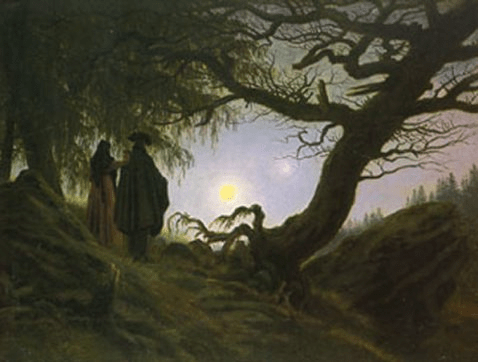
The drama of romanticism is distinguished by its infringement of the traditional rules of this genre, especially in form and presentation. The writers do not intend to produce this drama exclusively for the theater stage but also as a reading drama that plays out in the reader’s or audience’s fantasy. That leads to the drama taking an epic form and the storyline not leading to an intensifying point. The acting person in this drama is tempted by different dark, unclear powers; therefore, there is no unified relation between the plot and action. This contradicted existence of humans tries to present this drama.
Another central concern of that romantic drama is the restoration of inner harmony, which is human’s destination and leads to the union with God—and it also carries a religious-philosophical touch. The separation from God and its duration, which includes the separation from oneself, are defined through suffering.
The drama of romanticism certainly doesn’t intend to emphasize the plot’s pathetic and sublime because the sublime is to stand above destiny and reconcile with it. Achieving this union with himself and with God leads man to reach universality.
After romanticism ended around half of the 19th century, bourgeois (middle-class) Realism developed. Nonetheless, from 1850 to 1880, we can notice unsatisfactory progress in this drama; however, some theoretical approaches were formulated, which still have a remarkable influence. Between these formulations, you can find concepts from Friedrich Nietzsche. Nevertheless, it is pretty challenging to speak about a standard line regarding the bourgeois drama. This priority evolved later in modern literature, specifically under the polemic discourse between the Naturalists and the Realists. But suppose you still want to set up guidelines for this drama. In that case, you notice that there exists a tendency to use classical drama and confrontation with nature because humans were convinced that life is accurately reflected with social surroundings, politics, and the economy.
©2025, Vasiliki Papadopoulou, all rights reserved.
PS The picture is a painting by Caspar David Friedrich, A man and a woman contemplating the moon, created 1818-1824.


 Welcome to Vasos Storyland
Leave a reply to Willie Torres Jr. Cancel reply