

The European Union, or shortly, the EU, has been dictating Europe’s citizens’ lives for several decades and still does; some conceive it unconsciously, and others more profoundly. As for the population, outside of the European radius, they are only marginal or not affected at all. In any manner, the vision of Europe as a tangible concept has its roots deep into history. So, this article outlines the beginning and journey of Europe as a higher idea and purpose.
The history of this world develops a concrete picture of Europe very early. It starts with a myth from Greek Antiquity, which narrates how Zeus transformed into a bull, kidnapped Europe from her homeland, Phoenicia, and brought her to Crete. Already, at this point, a bridge between Europe and Asia arises.
A dichotomous setup also makes Herodotus by distinguishing Greeks from Europe and Persians from Asia. This thought of Herodotus has a defining influence on the upcoming Hellenistic literature. On the other hand, Hippocrates separates Europeans, as they govern or are governed by the law, from Orientals and their despotism.
Furthermore, geographical differentiations, like those of Isocrates, are being established; for him, Greece is synonymous with Europe. Then Aristotle goes a step further and sees the differences between cultures. According to Aristotle, European culture, including Greek culture, holds a higher status as part of the empire of the Scythians. Later, Alexander the Great and the Imperium Romanum establish the final determination of geographical and cultural differentiation. The Romans, especially, are trying to integrate into their Empire as devoted citizens.
Many centuries later, in the 7th and 8th, Isidore of Seville introduces another geographical separation: he differentiates between Europe, Asia, and Africa. Later, he requires the Carolingian Empire to make a cultural distinction from the Byzantine. Different languages exist, and there are more peculiarities between those two cultures. But both regard themselves as representatives of Western culture. However, this narrative ends with the Byzantium’s fall and the formation of the Ottoman Empire.
Looking at the Renaissance of the 16th century, we can see the idea of the independent state evolving, especially in terms of the justice system. That leads to precise conceptions of how a perfect united Europe should be structured. The beginning makes the Dutch theologian, humanist, and politician Hugo Grotius, who envisions a constitution of a Congress of the European States and a court that resolves intergovernmental controversies.
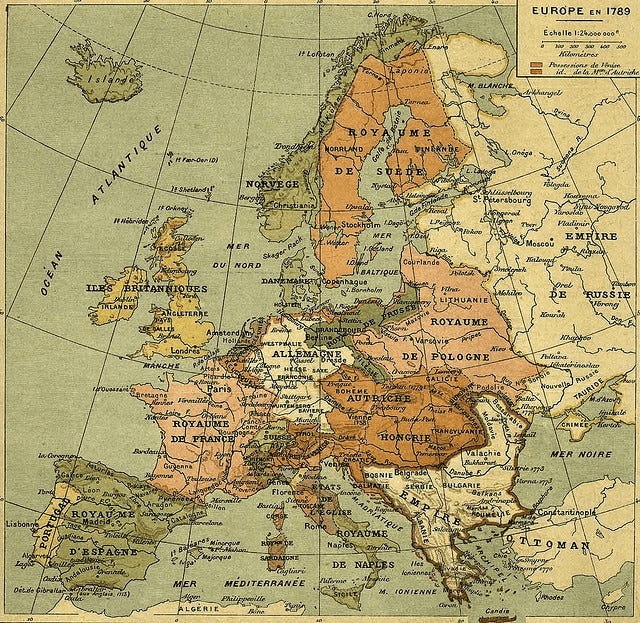
Then, after the conflict between the dynasties of Habsburg and Bourbon and the Peace of Utrecht in 1713, a pro-European policy with an article referring to fair power distribution to secure peace can be noticed.
Napoleon’s thoughts also revolve around a united Europe. According to Comte de Las Cases’s statements, Napoleon proposes a common currency, measures, weights, and legal system.
Saint Simon’s study in 1814 also reveals the idea of peacekeeping. He concludes that a federation of European Nations can only peacefully exist when each national state is governed by a parliament, which in turn is subjected to a general parliament voted by the governments of the European Nations. Therefore, economic integration plays an important role; it should be the first stage of cooperation among all nations. What Saint Simon is describing to us is a European Confederation.
First, indications of European structures can also be discovered in the final discussion of the Congress of Viena 1815, which results in the foundation of the „German Confederation” and the National Assembly in Frankfurt on the Main, where later representatives of each different government of the Confederation will gather.
To Europeanize the Confederation, non-German monarchs like the King of Great Britain, the Netherlands, and Denmark are integrated.
In the 20ies of the 20th century, precisely in 1923, the Count of Coudenhove-Kalergi Richard Nikolaus establishes the „Paneuropean Union.” Members of that Union are Albert Einstein, Thomas Mann, and Konrad Adenauer. The Union’s manifest states that its target is the association of the democratic countries of the European Continent to a political and economic partnership of convenience.
So, the crystallization of a European identity began with a cultural and geographical differentiation between Europe and Asia. Then, over the centuries, the birth of autonomous national states and their constitutions furthered the idea of a united Europe, leading to the association of various European nations based primarily on democratic and economic benefits.
©2024, Vasiliki Papadopoulou, all rights reserved.


 Welcome to Vasos Storyland
Leave a reply to papadosshortstories Cancel reply