

If you could have something named after you, what would it be?
I wouldn’t say name after, but more related to some person. And this is Aspasia.
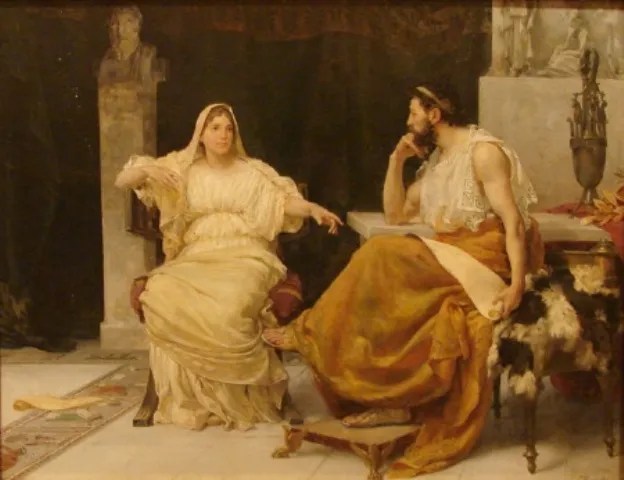
Aspasia, born in Miletus, was a woman in Classical Athens. Historians portray her role as controversial, but I will come to that later.
As said, she was born in Miletus around 470 B.C., and contrary to other girls, her father took her with him to the philosophical school. I should mention that in Ancient Greece, education was a privilege only for boys and men.
However, Aspasia became an excellent dance, music, song, rhetoric, and history student. Then, one day, she asked the famous architect Ipodamos to take her with him to Athens since philosophy was blooming there. Very soon, she started interacting with the intellectual circle of Athens and bought a house to teach philosophy lessons. Of course, since she was a woman in Ancient Athens, and the Athenian women had few legal rights and the right to have property, her actions caused an uproar of reactions; since she was born in Miletus, Aspasia was freed from this law. So she gained a lot of enemies.
And here comes her controversial role in history. She met Perikles, the general and politician of Athens, and became his lover, concubine. There were also rumors that she was a prostitute. A lot of roles were given to her. Even today, it is not sure whether these were rumors or facts.
However, it is said that Perikles, as well as Socrates, Plato, and other influential politicians, admired her intellect and smartness. With time, these attributes turned against her when people accused her of intervening in the political life of Athens through her influence on Perikles.
Overall, she had many supporters but also many enemies. Lastly, she enjoyed most of the privileges of an Athenian.
Now, you will wonder why I identify myself with her. The reason is that education, specifically philosophical education, is essential to me. Today, mainly in all countries (unfortunately, there are still countries that can’t provide that), but considering the time Aspasia lived when a married woman couldn’t even leave the house, she was known for her philosophical knowledge in Athens and not only. Moreover, as a woman, she risked, overcame moral and legal laws, and fought against the male-dominated system to pursue her dream and spiritual evolution. So, I think I can say she was the first independent woman and feminist in Ancient Greece.
 Welcome to Vasos Storyland
Leave a comment